
Selecting a proper industrial shredder for metal recycling hinges on aligning your scrap metal’s physical characteristics with the machine’s mechanical structure, torque performance and processing capacity. A mismatched shredder model will easily cause frequent jams, accelerated blade abrasion and insufficient production throughput, hindering normal recycling operations.
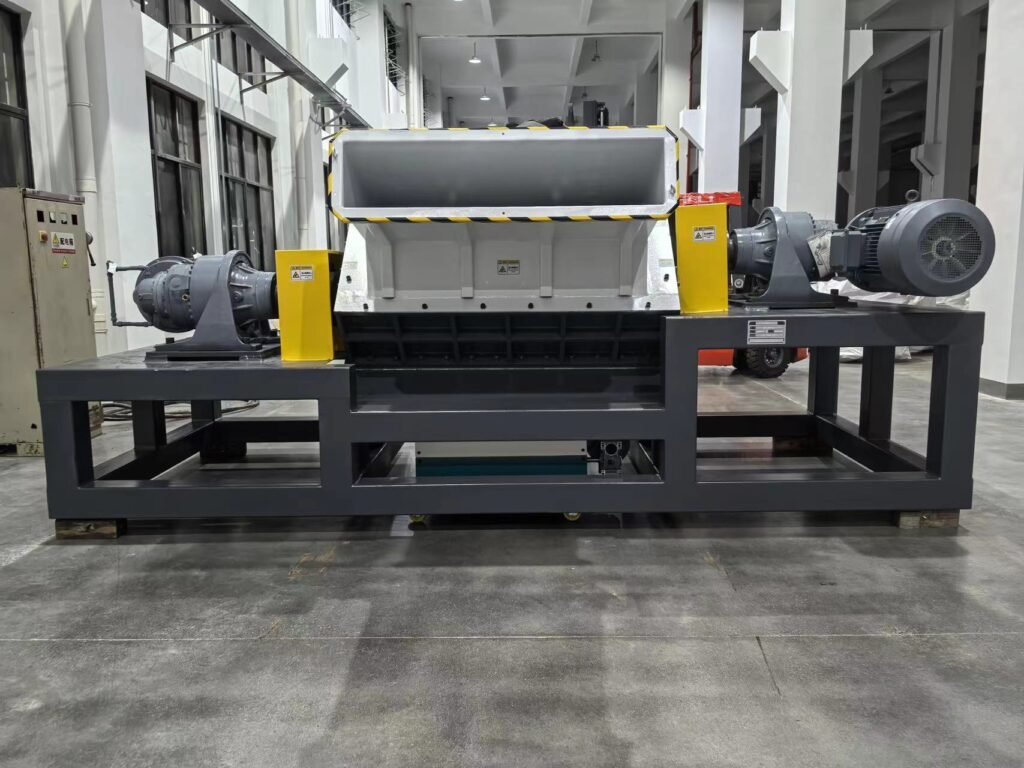
1.Confirm Scrap Metal Type and Processing Volume-feature of industrial shredder for metal recycling
The structural features, thickness and hardness of scrap materials are the core basis for determining the right shredding mechanism. Different metal scraps require targeted shredding solutions:
Light non-ferrous metal and electronic scrap: Copper wires, aluminum profiles, printed circuit boards (PCBs) and similar materials demand precise, fine cutting processing.
Light ferrous metal and bulky scrap: Household appliances, metal drums, metal sheets and other bulky scraps rely on strong tearing force for effective shredding.
Heavy steel and heavy melting steel (HMS): Vehicle hulls, building steel beams, thick steel plates and other heavy-duty materials require powerful kinetic impact or high-intensity shearing force to break down.
Besides material types, calculate your hourly tonnage (TPH) production demand to match the appropriate motor power and hopper specification, ensuring the machine meets your actual production scale.
2. Pick the Right Shredding Mechanism- Industrial Shredder type
Each type of metal shredder features a unique mechanical design, with distinct trade-offs in torque output, processing speed and finished particle uniformity. You can select equipment based on your actual processing needs:
| Shredder Type | Cutting Mechanism | Ideal Applications | Core Advantages |
|---|---|---|---|
| Single-Shaft Shredder | Equipped with a single rotating rotor cooperating with fixed counter knives | Aluminum profiles, copper cables, electronic scrap | High cutting precision; compatible with sizing screens to produce fine, uniform finished particles |
| Double-Shaft Shredder | Adopts interlocking counter-rotating blades to automatically grip and pull in materials | Baled aluminum materials, metal drums, mixed construction scrap metal | Delivers high torque at low rotating speed, ideal for high-volume processing of bulky scraps |
| Four-Shaft (Quad) Shredder | Consists of two main shredding shafts and two auxiliary cleaning shafts | Electronic waste, complex mixed metal scraps, material data destruction | Completes multi-stage crushing in one pass, enabling precise control over finished material size |
| Hammer Mill | Uses high-speed rotating drums with movable iron hammers for impact crushing | Car shells, engine blocks, large household white goods and other heavy scraps | Powerful fragmentation effect, which effectively removes surface rust, paint and dirt from metal materials |
3. Assess Key Specifications and Structural Design
Beyond the core shredding chamber, a series of detailed technical configurations directly affect daily operational efficiency and long-term equipment return on investment:
Drive System (Electric / Hydraulic): Electric drive systems equipped with high-efficiency motors (e.g., IE4 grade) feature stable operation and lower energy consumption, suitable for continuous and fixed production lines. Hydraulic drive systems provide adjustable speed and zero-speed maximum torque, delivering better adaptability to sudden load impacts and material jams in heavy-duty processing scenarios.
Intelligent overload protection: Prioritize shredders fitted with PLC intelligent control systems. When encountering unshreddable foreign matter, the system will automatically reverse the shaft rotation to clear blockages, effectively avoiding blade damage and equipment failure.
Maintenance-friendly design: Metal shredding brings severe wear and tear to cutter tools. Choose equipment with independently replaceable bolt-on blades, automatic lubrication systems and direct-access maintenance hatches to greatly reduce maintenance time and downtime losses.
4. Reserve Expansion Space for Downstream Sorting
Shredding is only the preliminary step of profitable metal recycling; efficient sorting of shredded materials is key to improving resource utilization. It is essential to select a shredder that can be seamlessly connected to modular downstream sorting systems, including:
Magnetic Drum Separators: Automatically separate ferrous metals such as iron and steel from mixed materials.
Eddy Current Separators: Precisely screen and extract non-ferrous metals like aluminum and copper from mixed material streams.
Air Classifiers: Remove light non-metallic impurities such as plastic films, rubber and foam to purify recycled metal materials.
To help you match the most suitable shredder configuration for your facility, please provide specific information about your production operations:
- What are your main types of scrap metal for processing (e.g., copper wires, car bodies, aluminum cans)?
- What is your hourly or daily material processing tonnage requirement?
- What finished particle size do you need (e.g., strip-shaped fragments, fine granules, 50mm uniform particles)?
